Tilapia cage farming software: what to track per cage
Software for tilapia cage farming: records per cage, feeding from the boat, stock moves when grading, and harvest by cage on shared water.
4 min read
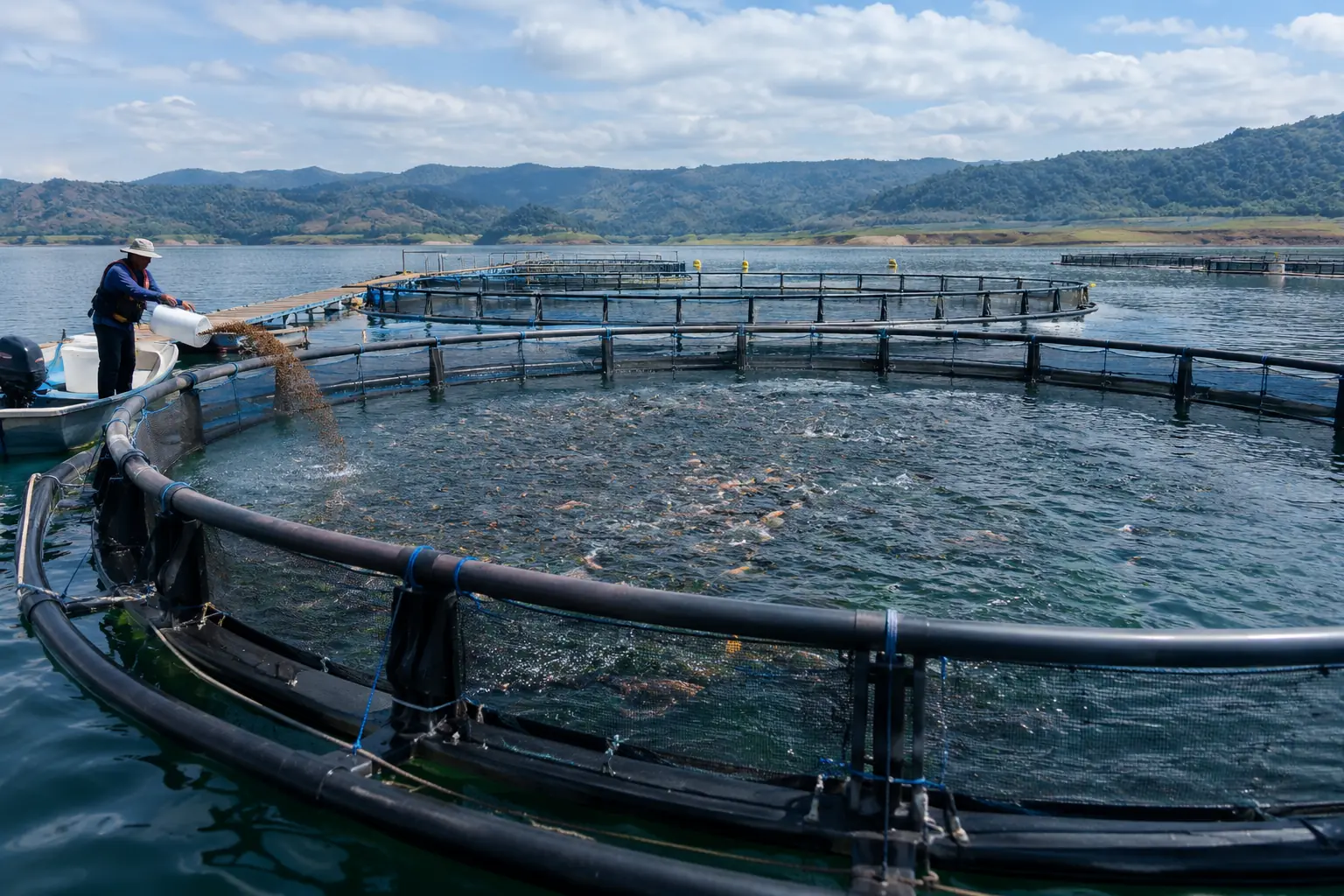
Tilapia in floating cages, on reservoirs, lakes and dams, runs on a different logic from ponds. There is no water surface of its own and no exchange per unit. The farm is a row of cages on shared water, it is fed from a boat, and its fish change cage every time they are graded. Software that works for an earthen pond does not always work on the water.
This guide walks through what the record of a cage farm has to hold, and how to recognise in a demo whether a system holds it.
The unit is the cage, not the reservoir
The temptation in cage culture is to keep the record per module or per reservoir, because the water is one body. But the fish do not live in the reservoir. They live in a cage, with its own stocking density, its own ration and its own history. A reservoir average hides the cage with the damaged net, the one that lost fish in the last grading and the one falling behind on growth.
The record has to treat each cage as a growing unit in its own right, with the batch it holds, and roll up to the module and the site when the overview is needed. If the system only knows how to describe ponds, the cage ends up recorded as a pond with no area, and every calculation that depends on area stops making sense.
Feeding happens from the boat, and is confirmed or lost
In cages the ration is handed out by boat along the row, cage by cage. The plan can be perfect in the office. What matters is what actually went into each cage: the one skipped because of the wind, the one that got half a ration because the boat ran out, the day nothing was fed because of the water.
A daily plan per cage that the crew confirms on return, including the not-fed days, is the difference between a feed conversion figure that measures the fish and one that measures the plan. If the software assumes the plan was carried out, every error on the boat disappears inside the cycle FCR.
Grading means moving fish between cages
In tilapia, grading is routine, and in cages every grading is a transfer: one cage empties into two or three by size, or several small cages are merged into one. Each move splits or merges batches, and each child batch has to take its count, its biomass and its history with it.
This is where spreadsheets break. If the grading does not reconcile against the source cage before it closes, fish that “vanish” between cages turn into invented mortality or phantom stock, and nobody knows which. The record needs grading sessions that balance against the source and lineage that follows each batch through the splits.
Mortality per cage, with its cause
Cage mortality is removed cage by cage, from the walkway or, on some farms, by divers. Recording it per cage and with a cause shows whether the problem is one cage, one module or the whole reservoir, which are three different diagnoses with three different responses.
The water is shared, the consequences are not
A low-oxygen event or a sharp temperature change in the reservoir hits many cages at once, but not all equally: the cages carrying the most biomass demand the most oxygen. When water quality readings sit in the same record as each cage’s population, the next day’s mortality is read against the water that caused it, without rebuilding the story from two systems.
Harvest comes out by cage
Cage harvest usually runs cage by cage or in groups, depending on the order and the size. A harvest record per cage and per destination closes each batch’s cycle with its real weight, and that figure against the last biomass estimate is the best measure of how well the cage was tracked through the cycle.
What to test in the demo
- A cage as its own unit. Set up a cage and check that the system does not ask for a pond area or treat it as a pond.
- An incomplete boat day. Record one cage not fed and another on half a ration, and see how each one’s conversion changes.
- A one-to-three grading. Empty one cage into three by size, with a residual left in the source, and check the count and biomass of all four.
- The morning after. Ask for last night’s oxygen readings next to today’s mortality for every cage in the module.
For what tilapia software has to record in general, in ponds or in cages, the guide to tilapia farm management software covers the full cycle.