Aquaculture software API and integrations
AquaOS connects to what you already run. Sensors and controllers feed data in, and a documented API lets your other systems read it back out. It sits in the middle of your setup rather than on top of it, and API access is included rather than sold as an upgrade.
- RS-485 Modbus RTU, analog, I2C, 1-Wire
- Token-authenticated REST API
- Outbound webhooks on alarms
- XLSX and PDF export on every report
Getting data into AquaOS
Three paths, and most deployments use more than one.
Field controllers
The primary path.
A controller reads its attached sensors on an interval and delivers signed messages to the platform over cellular. Readings land bound to the growing unit the sensor is assigned to. When the cellular link is down the controller buffers locally and delivers the backlog on recovery, so the stored history has no gap.
Manual and mobile entry
Production events, feeding confirmations, mortality, sampling, and handheld water quality readings are entered through the web workspace or the mobile app.
Manually entered readings sit in the same history as continuous sensor data.
API ingest
Other systems can send readings and events into AquaOS through the API.
This is the route for a data logger from another supplier, a control system you already have, or a lab system holding measurements you want in the same record.
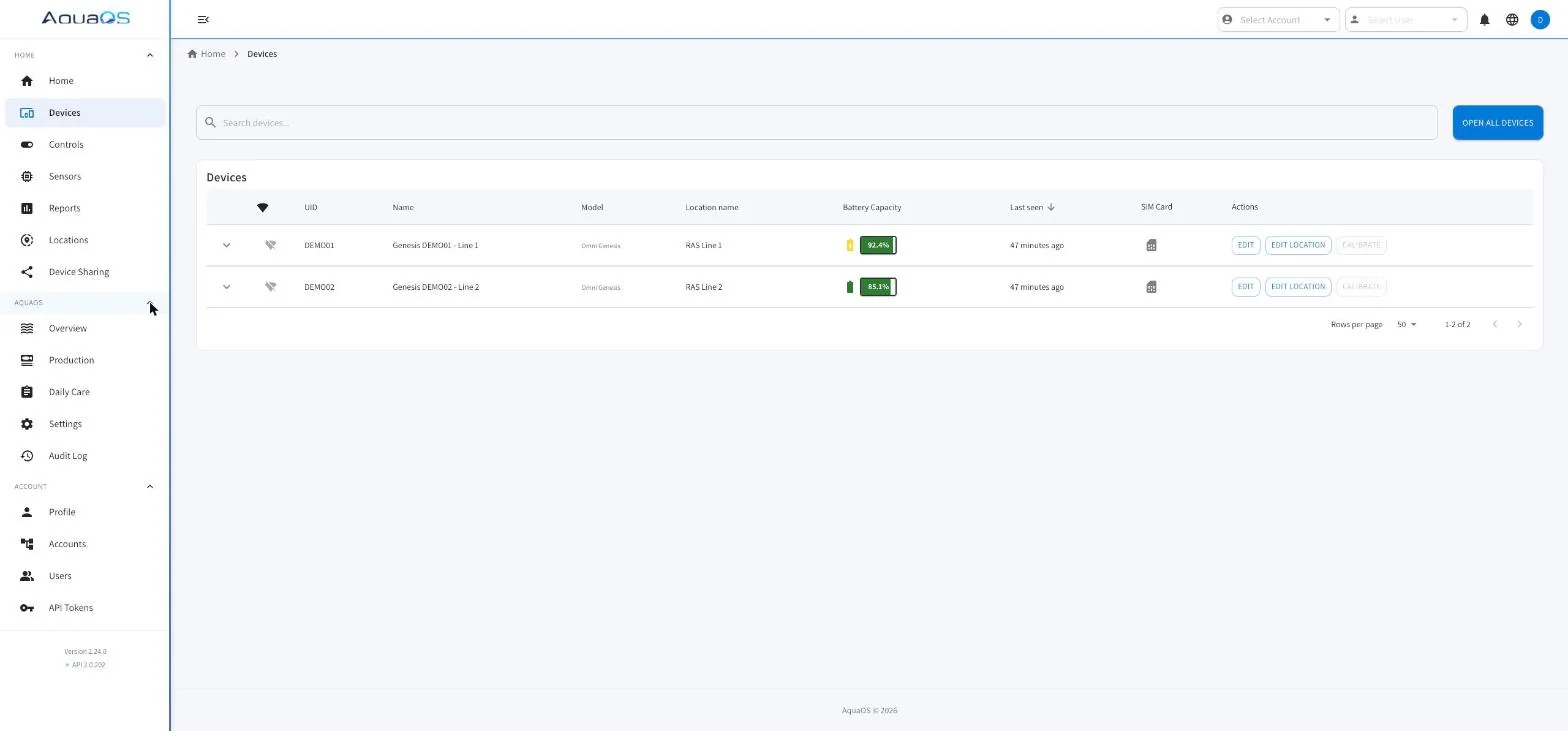
Sensor and device support
AquaOS is sensor-agnostic. Support is a property of the controller layer, and a sensor is configured per unit in the platform rather than requiring a firmware change.
- RS-485 Modbus RTU
- The main digital path. Most modern industrial water quality probes.
- Analog
- Voltage and current-loop outputs from older or simpler probes.
- I2C
- Board-level and compact environmental sensors.
- 1-Wire
- Digital temperature probes.
- Cellular uplink
- Controller to platform. No site network or Wi-Fi required at the pond.
Reading the production record programmatically
Each connected system gets its own access key, separate from any person login, so it can be switched off on its own. The data is organised the way the platform is: sites hold growing units, units hold the stock in them, and every reading belongs to a unit.
Resources
- Sites and growing units
- The physical model: sites, units, unit types, area and volume.
- Sensors and readings
- Devices, their unit binding, and the time-series readings they produced.
- Batches and placements
- Stock identity, where it sits, counts, average weight, and biomass.
- Events
- Stocking, splits, transfers, sorts, sampling, mortality, and closures.
- Alarms
- Threshold breaches, their unit, and acknowledgement state.
Access
curl https://api.aquaos.ai/v1/sites \
  -H "Authorization: Bearer $AQUAOS_TOKEN" \
  -H "Accept: application/json"
Every integration gets its own access key, and each one can be switched off separately. Ask us for the current API documentation before you start building.
Talk to the teamGetting data out of AquaOS
REST reads
Pull sites, units, sensors, readings, batches, and events into a BI tool, a data warehouse, an ERP, or an accounting system on your own schedule.
Webhooks
Outbound calls fire on alarms so an external system can react without polling. Useful for routing into an existing on-call or incident tool.
File export
Every report exports to XLSX and print-ready PDF. XLSX rather than CSV, because spreadsheet software re-encodes CSV on save and corrupts non-Latin text in the process.
Notifications
Alarm delivery to the people on duty, so the operational response does not depend on someone having a dashboard open.
Frequently asked questions
Is API access included, or is it an enterprise add-on?
It is part of the platform. Every integration gets its own access key. There is no separate enterprise tier that unlocks the API, because a platform that holds your production data and charges extra to read it back is not an open platform.
Can AquaOS ingest data from a system we already run?
Yes, through the API. A data logger from another supplier, a control system you already have, or a lab system can send readings and events in, so they live in the same production record as everything else.
Which sensor protocols are supported?
RS-485 Modbus RTU is the main digital path and covers most modern industrial water quality probes. Analog voltage and current-loop outputs, I2C, and 1-Wire are also supported at the controller layer. Whether a specific probe works is a question of its output and register map, worth asking with the model number in hand.
Does AquaOS support LoRaWAN?
Cellular is the connectivity that ships and is supported, and it is what makes remote pond deployment practical without a site network. The controllers are modular by design, so other radio options are a hardware question worth raising with your site layout and the model numbers in hand.
How are integrations authenticated?
Each integration gets its own access key, separate from any personal login. A key can be switched off on its own, so removing an integration never means changing a password or disabling an account.
See AquaOS on your operation
Bring a real production scenario. AquaOS is walked through on your operation, not a canned dataset.