RAS management software for recirculating aquaculture systems
AquaOS is management software for recirculating aquaculture systems, holding the production record and the water quality history at tank level. A recirculating system runs at densities where a few hours of bad water is a total loss, and where every tank shares the same treatment loop.
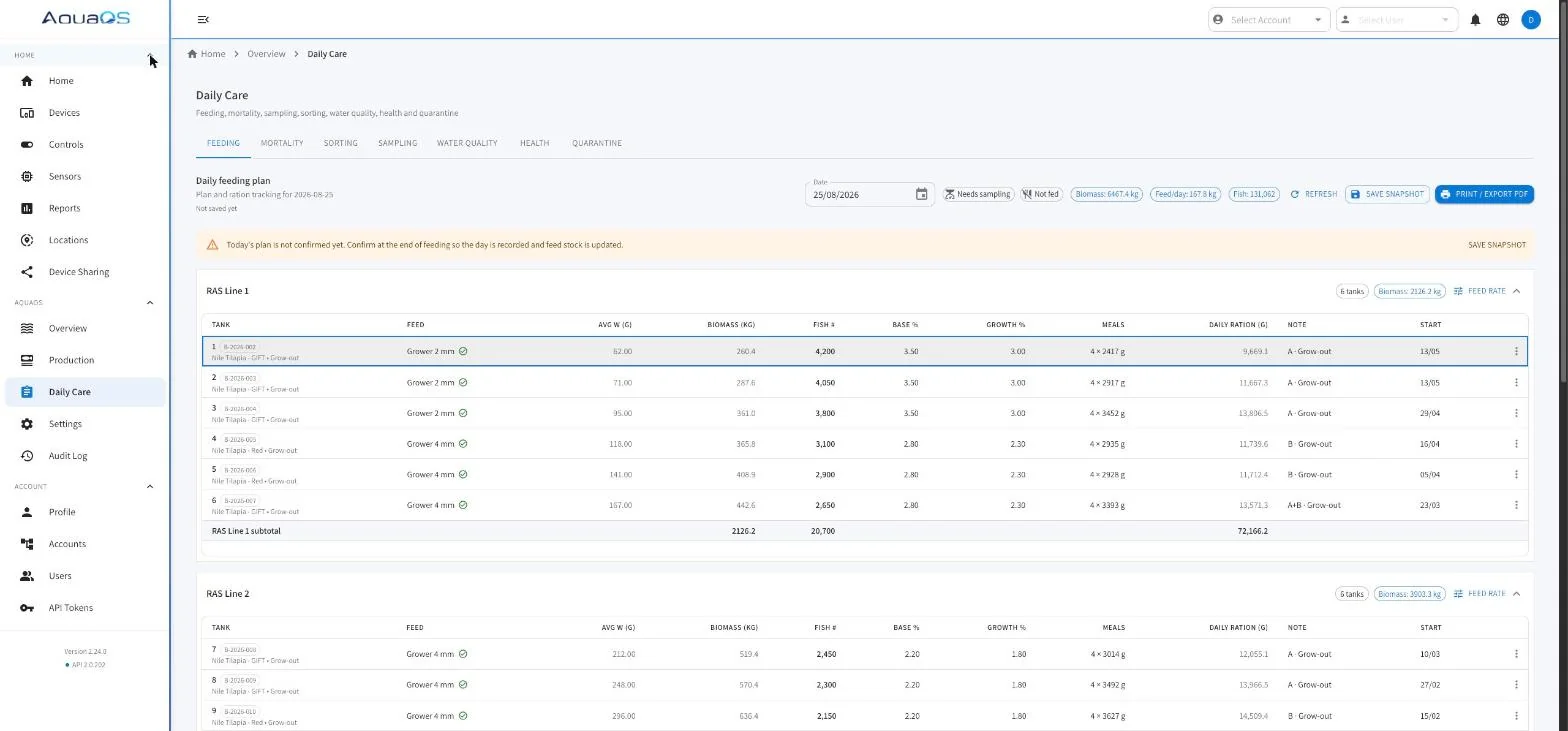
- Batch record per tank
- Continuous monitoring on every tank
- Threshold alarms with notification
- System-wide rollups from tank data
How AquaOS fits a recirculating facility
Tank-level granularity
Every tank is a growing unit with its own batch, feed record, mortality, and sensor history.
Density and biomass per tank are current after every event, which is what lets a facility run close to its design limit without guessing where the margin is.
Continuous water quality per tank
Dissolved oxygen, temperature, pH, and the nitrogen parameters read continuously and bound to the tank they were measured in.
Because the sensor is assigned to a growing unit, the reading history stays attached to whatever batch was in that tank at the time.
Alarms that name a tank
Per-sensor thresholds raise alarms that reach the people on duty and appear on the dashboard against the unit.
At 03:40 the useful alarm names a tank and the batch in it, not a device identifier someone has to look up.
Dense stocking, frequent moves
RAS operations grade and redistribute stock often to hold density inside a band.
Splits, transfers, and sorting sessions are tracked events that update both ends immediately, so the density figure driving the next decision is not a day old.
Feeding matched to the phase
Rations come from a feed matrix keyed to species, weight band, and cultivation phase, with the number of daily feedings set per phase.
Confirmed feedings and skipped days are recorded, so feed input to the system is a known quantity rather than an estimate.
System rollups from real data
Total biomass, total feed input, and mortality across the hall are computed from the tank records rather than maintained separately.
The system view and the tank view cannot disagree because one is derived from the other.
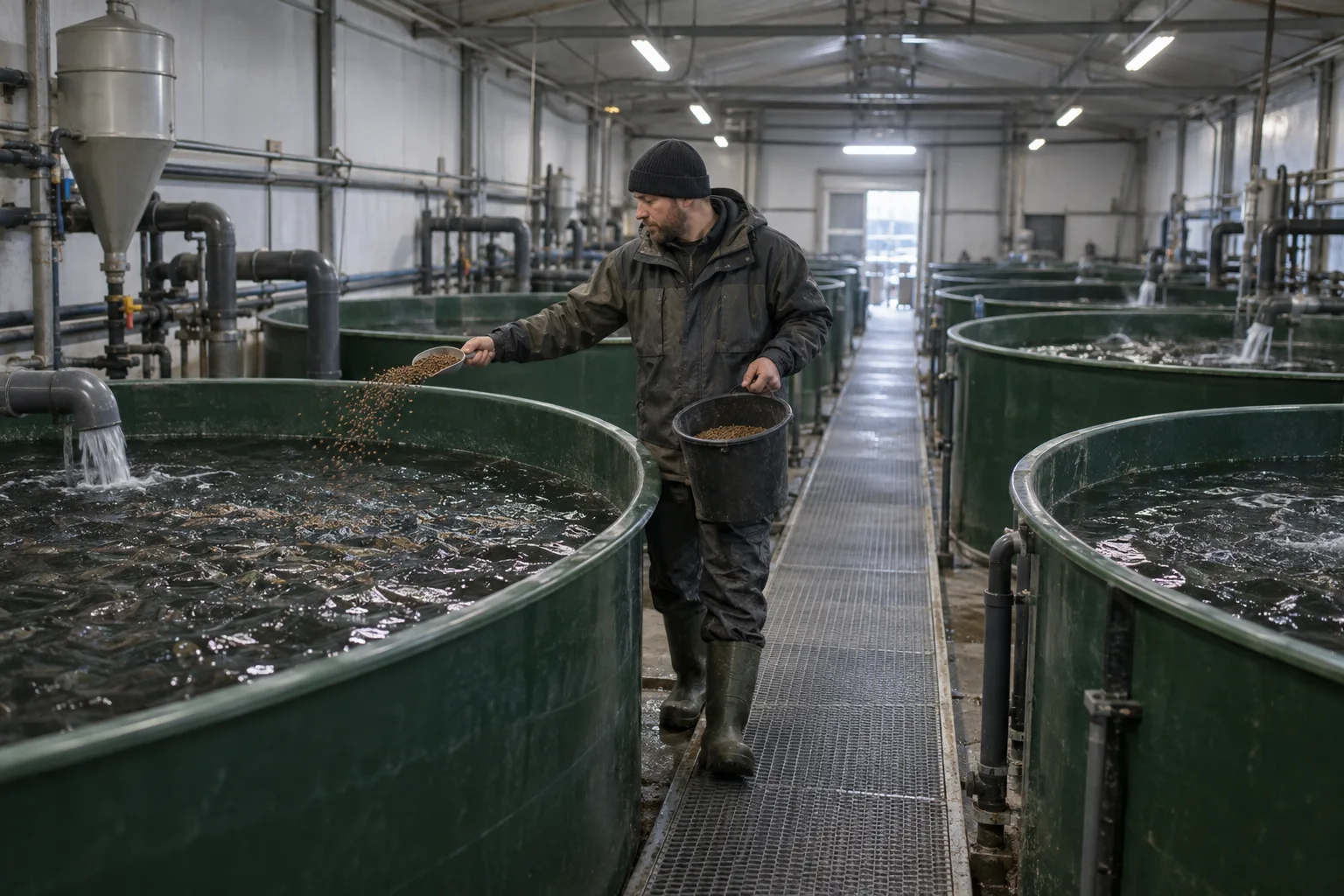
What tank-level records give a RAS
Load on the system is a known number
Biomass and feed input drive the load on biofiltration. When both are current and per tank, the total is real rather than an assumption carried forward from the last time someone added it up.
Incidents are reconstructable
When a parameter excursion causes a loss, the reading history, the feeding that day, the density, and the mortality that followed all come off one report for that tank and period.
Density stays inside the band
Because splits and grading update biomass immediately, the density figure a manager uses to decide the next move reflects the last move rather than the one before it.
Related reading
Water quality monitoring
How readings are bound to units, alarmed, and buffered when a link drops.
Production tracking
Batches, placements, and the splits that keep density current.
Hardware
The sensors and controllers behind the continuous readings.
Stocking density calculator
Animals to order for a tank, and the biomass it will carry at harvest.
Growth rate calculator (SGR)
Specific growth rate and daily gain between two samplings.
Feed conversion ratio (FCR) calculator
Feed conversion ratio from feed given and biomass gained.
Frequently asked questions
Does AquaOS control RAS equipment such as pumps and aerators?
AquaOS records, monitors, and alarms, and control outputs exist at the controller layer. Facilities typically keep their existing control layer and use AquaOS for the production record, the water quality history, and alarming. What is worth automating depends on the equipment, so it is a conversation to have with your hardware list in hand.
Can water quality be monitored on every tank individually?
Yes. Sensors are assigned per growing unit, so a hall with many tanks can have per-tank readings rather than a single loop measurement standing in for all of them. How many tanks are instrumented is a hardware decision, not a platform limit.
How are nitrogen parameters handled?
Ammonium and nitrate are read from the installed sensors like any other parameter, bound to the tank, alarmed against thresholds, and plotted on the per-unit report. AquaOS records and presents them; it does not model biofilter performance.
Can one system view show all tanks at once?
Yes. The dashboard shows the units in a site with their stocking state and sensor status, and reporting rolls tank-level records up to the site level. The rollup is computed from the tank data rather than maintained as a separate figure.
See AquaOS on your operation
Bring a real production scenario. AquaOS is walked through on your operation, not a canned dataset.