Shrimp farm management software
AquaOS is shrimp farm management software for pond-level stocking, feeding, mortality and water quality. A shrimp operation is a set of ponds that each run their own cycle, on their own feed curve, with their own water. AquaOS holds each pond as its own production record and rolls them up when you need the farm view.
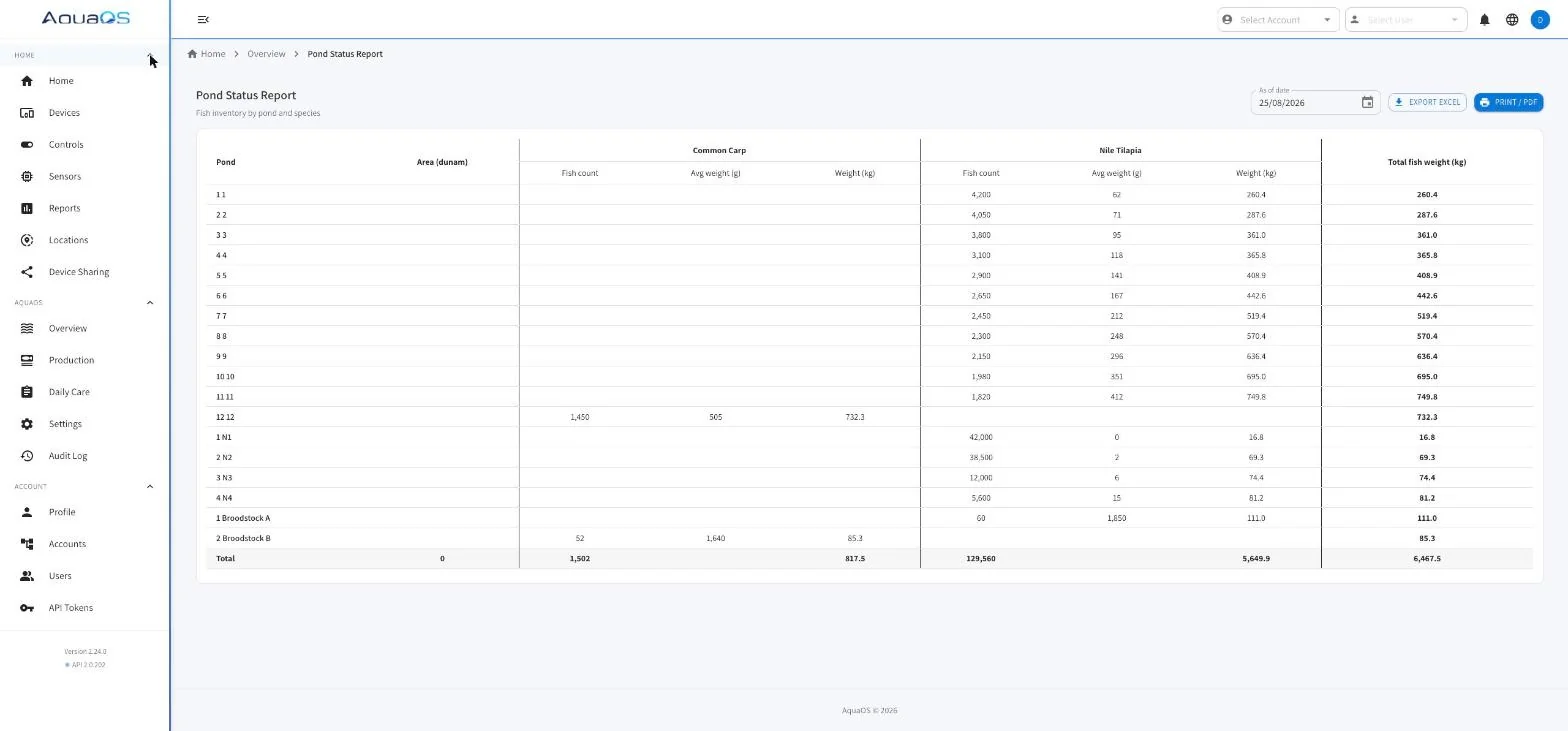
- Pond-level stocking and cycles
- Feed tables by species and weight band
- Cellular monitoring for remote clusters
- Site and multi-site rollups
How AquaOS fits the pond cycle
Each pond is its own cycle
Ponds stock, grow, and harvest on their own schedule.
Each carries its own batch, its own feed record, its own mortality, and its own water quality history. The farm view is a rollup of those records rather than a substitute for them.
Feed tables by weight band
Shrimp feeding is driven by a table of rates against weight band and phase, and that table is farm-specific.
AquaOS holds the operation own matrix and calculates a daily ration per pond from current biomass, so the plan changes as the animals grow without anyone re-deriving it.
Feed cost visibility
Feed is the dominant cost in a shrimp cycle.
Confirmed feedings become the feed record, feed items draw down stock, and runway shows how many days remain before the next delivery has to land.
Remote pond clusters
Pond clusters are rarely near a network.
Controllers are cellular-native, so monitoring reaches ponds with no site infrastructure, and readings buffer locally when the cellular link drops.
Water quality where it decides the cycle
Dissolved oxygen, temperature, pH, and salinity-related parameters read continuously and bound to the pond.
Threshold alarms reach the people on duty, and the reading history sits on the same report as the mortality it explains.
Partial and staged harvest
Stock can leave a pond partially, whether for a staged harvest or a transfer.
The residual remains an accurate live placement, so the pond keeps reporting a correct count and the feed plan follows it down.
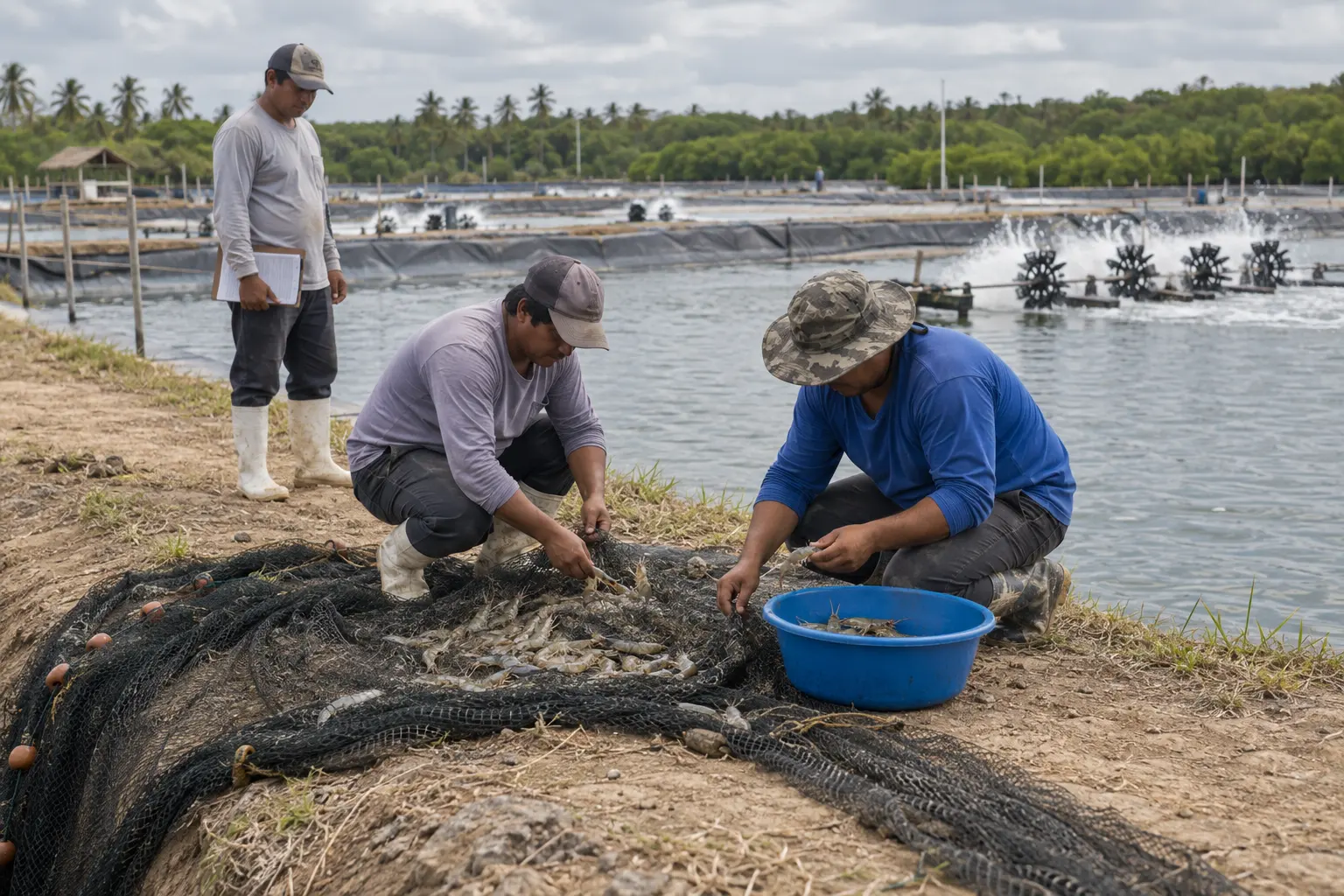
What changes across a cycle
Feed conversion per pond, not per farm
A farm-level FCR hides the ponds that are performing badly behind the ones that are not. Per-pond records make the variance visible while there is still cycle left to act on.
Night events have a record
An overnight oxygen event on a remote pond is captured with timestamps, whether or not anyone was watching, and the mortality that followed sits next to it.
Cycle comparison
Because each pond keeps its complete history after harvest, this cycle can be compared against the last one on the same pond, in growth, feed, and mortality.
Related reading
Shrimp hatchery software
Where the postlarvae come from, and what the lab supplying them has to record.
Water quality monitoring
Continuous readings bound to the pond, alarms, and offline buffering.
Shrimp farm production control
Where the shared Excel workbook breaks on a shrimp farm, and what replaces it.
Shrimp farm software: how to choose
Spreadsheet, field app, sensor dashboard or production platform, and what to test in a demo.
Shrimp biomass calculator
Live count, pond biomass, kg per hectare and daily ration from one sampling.
Stocking density calculator
Postlarvae to order for a pond, and the load it will carry at harvest.
Growth rate calculator (SGR)
Specific growth rate and daily gain between two samplings.
Feed runway calculator
Days of feed left, the run-out date and the date to order by.
Shrimp farm record keeping template
An Excel workbook with a daily pond log and stocking, sampling and harvest sheets.
Frequently asked questions
Does AquaOS work for vannamei and monodon?
Yes. Species and varieties are configured per operation, and the feed matrix is defined per species and weight band by the farm. The platform does not assume a species, which is also why it runs for operations that keep more than one.
Can it handle a farm with dozens of ponds across several sites?
Yes. The platform is multi-site and multi-user. Each pond is a growing unit under a site, each site has its own units and users, and reporting rolls up from the pond to the site to the whole operation.
How does monitoring reach ponds with no network?
Field controllers connect over cellular and need no site network. When cellular drops, readings are buffered on the controller and delivered when it recovers, so the history has no gap for the period the link was down.
Can we start with production tracking and add sensors later?
Yes. Stocking, feeding, mortality, and reporting all work on manually entered data. Sensors join the same record whenever they are installed, without redoing the setup.
See AquaOS on your operation
Bring a real production scenario. AquaOS is walked through on your operation, not a canned dataset.