Tambaqui and cachama farm software: what to track
Software for tambaqui and cachama farming: species and hybrids kept distinct, ponds shared with tilapia, feed by weight band and harvest by size.
3 min read
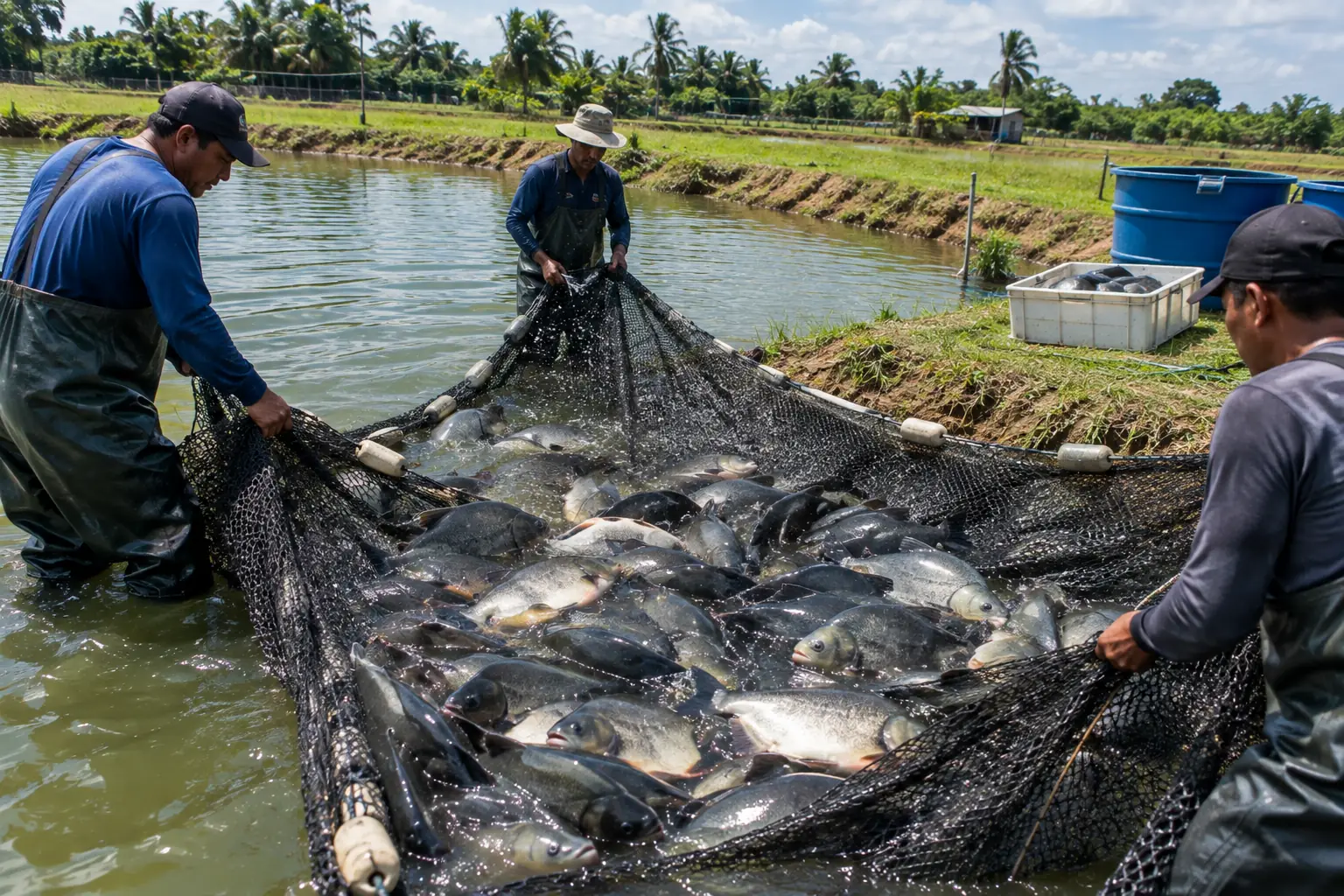
Tambaqui and cachama are among the most farmed native species of the Orinoco and Amazon basins, in Colombia, Venezuela, Brazil and Peru, nearly always in earthen ponds and often on the same farm as tilapia. Much aquaculture software is built around salmon, tilapia or shrimp, and cachama ends up as one more entry in a species list. This guide covers what the record of a cachama farm has to hold for its numbers to be useful.
One name, several species
“Cachama” on a farm can mean different things. Cachama negra is Colossoma macropomum, the tambaqui of Brazil and the gamitana of Peru. Cachama blanca is Piaractus brachypomus, called pirapitinga in Brazil. And in several regions hybrids between the two genera are farmed, such as tambacu and tambatinga in Brazil.
For the record this is not a naming detail. Each grows differently and sells differently, and a report that adds them up under “cachama” hides exactly the comparison the farm needs. The software has to carry species and variety or hybrid as one resolved identity on every batch, so no rollup drops half the information when it groups.
Ponds shared with tilapia
Cachama commonly shares the farm with tilapia, and sometimes the same pond. A pond holding two species is not a mixed batch. It is two batches in one unit, each with its own stocking, count, samplings and mortality.
If the record only allows one batch per pond, polyculture ends up written down as a single population, and at harvest there is no way to know how much each species contributed or how each one grew. A system that holds several batches in the same growing unit, each with its own history, solves that without parallel spreadsheets.
Feed by weight band, from the farm’s own table
Feeding tables for cachama vary widely between feed manufacturers and between farms, and there is no universal table that fits everyone. What works is the farm’s own table, by species, weight band and phase, producing the daily ration for each pond, and a record that confirms what was actually delivered, including the not-fed days.
With that, feed conversion and growth rate are calculated per pond and per species between every two samplings, which is the only way to know whether a pond is doing well or only looks fine inside the farm average.
Harvest by size and by destination
Cachama is largely sold whole and by size, to local markets and to traders, often through partial harvests of the same pond. Recording each harvest with its size, weight and destination closes each batch’s cycle with real figures and leaves a history for planning the next one: which pond reached which size, in how long, and on how much feed.
What to test in the demo
- Three distinct identities. Set up cachama negra, cachama blanca and a hybrid, and check that a report does not merge them.
- A pond with two species. Stock cachama and tilapia in the same pond and record a sampling of each separately.
- The farm’s own table. Load your farm’s cachama feeding table and see the daily ration it produces.
- Two partial harvests. Harvest part of a pond to one destination and the rest to another, and check how the batch closes.
For the part of the cycle cachama shares with other finfish species, see fish farm management software.