Aquaculture sensors and controllers
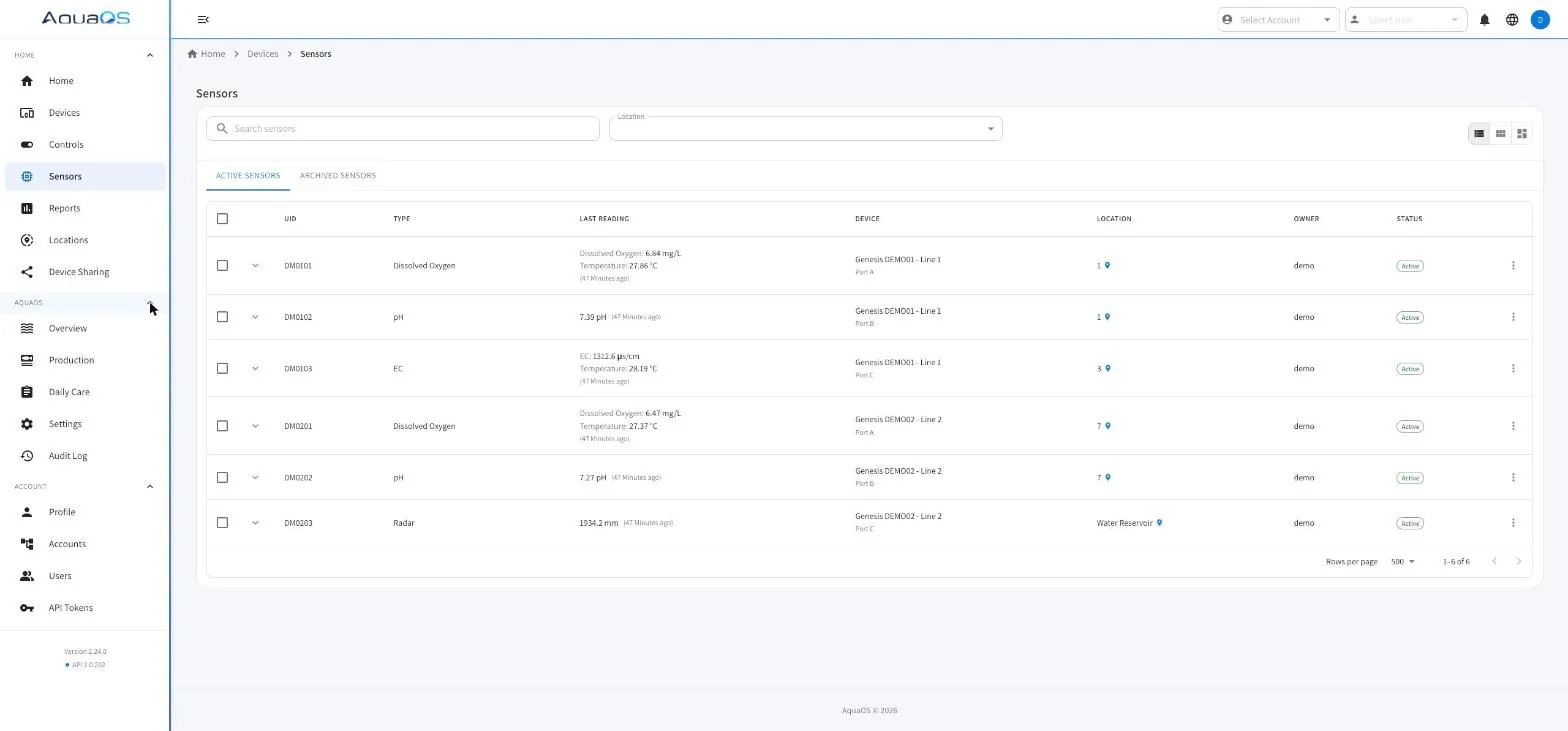
AquaOS is software, and it reads from a hardware layer built by the same company. That is the unusual part: the sensor, the controller, and the production record are one product line rather than three vendors and an integration contract.
- Any modern industrial sensor
- Cellular-native controllers
- Local buffering when offline
- Existing hardware stays in service
What sits between the water and the record
Sensors
Industrial probes for dissolved oxygen, pH, temperature, electrical conductivity, ORP, ammonium, nitrate, turbidity, and other parameters.
AquaOS is sensor-agnostic: probes are configured in the platform rather than requiring a firmware change, so the parameter list follows what is installed on site.
Controllers
Field controllers read the connected sensors on an interval and deliver readings to the platform over cellular.
They run on battery with deep-sleep cycles and are built for outdoor pond-edge installation rather than a control room.
Cellular, not site network
Remote ponds rarely have network coverage at the water.
Controllers connect over cellular directly, so a deployment does not begin with a site networking project. When the cellular link drops, readings are buffered on the controller and delivered when it recovers.
Your existing sensors
There is no requirement to replace working hardware to adopt AquaOS.
Third-party industrial sensors connect through the controller layer and are configured per sensor in the platform. Hardware that already reads correctly keeps reading.
Software first is a valid start
AquaOS runs fully on manually entered production data.
Many operations start with production tracking, feeding, and reporting, then instrument the units where continuous water quality actually changes a decision.
One party accountable
When a reading does not reach the report, there is a single vendor to call.
This is the practical value of hardware and software from one company, and it is not available from a software-only platform paired with a sensor supplier.
Frequently asked questions
Do we have to buy hardware to use AquaOS?
No. The platform works fully on manually entered production data. Sensors add continuous water quality to the same record and can be added at any point, on the units where it matters, without redoing the setup.
Will AquaOS work with sensors we already own?
In most cases yes. Modern industrial sensors connect through the controller layer and are configured per sensor in the platform. Whether a specific probe is supported depends on its output and protocol, which is a question worth putting to the team with the model number in hand.
What connectivity do the controllers use?
Cellular is the shipping connectivity, which is what makes remote pond deployment practical without a site network. The controllers are modular by design and other radio options are possible as a hardware capability, but cellular is what is deployed and supported today.
Where can I see full sensor specifications?
Ask us for the datasheet of any sensor you are considering. Specifications are supplied per model rather than published as a catalogue here, because the right probe depends on the water, the parameter and the deployment.
See AquaOS on your operation
Bring a real production scenario. AquaOS is walked through on your operation, not a canned dataset.