Aquaculture hatchery management software
AquaOS is aquaculture hatchery management software for fish and shrimp hatcheries, covering broodstock, spawning, hatch and nursery, and the splitting and grading that fill the week between them. A hatchery week is not a grow-out month at higher frequency. It is dominated by moving populations between units as density and size class change, several times a week, at counts no notebook survives. AquaOS is shaped around exactly that.
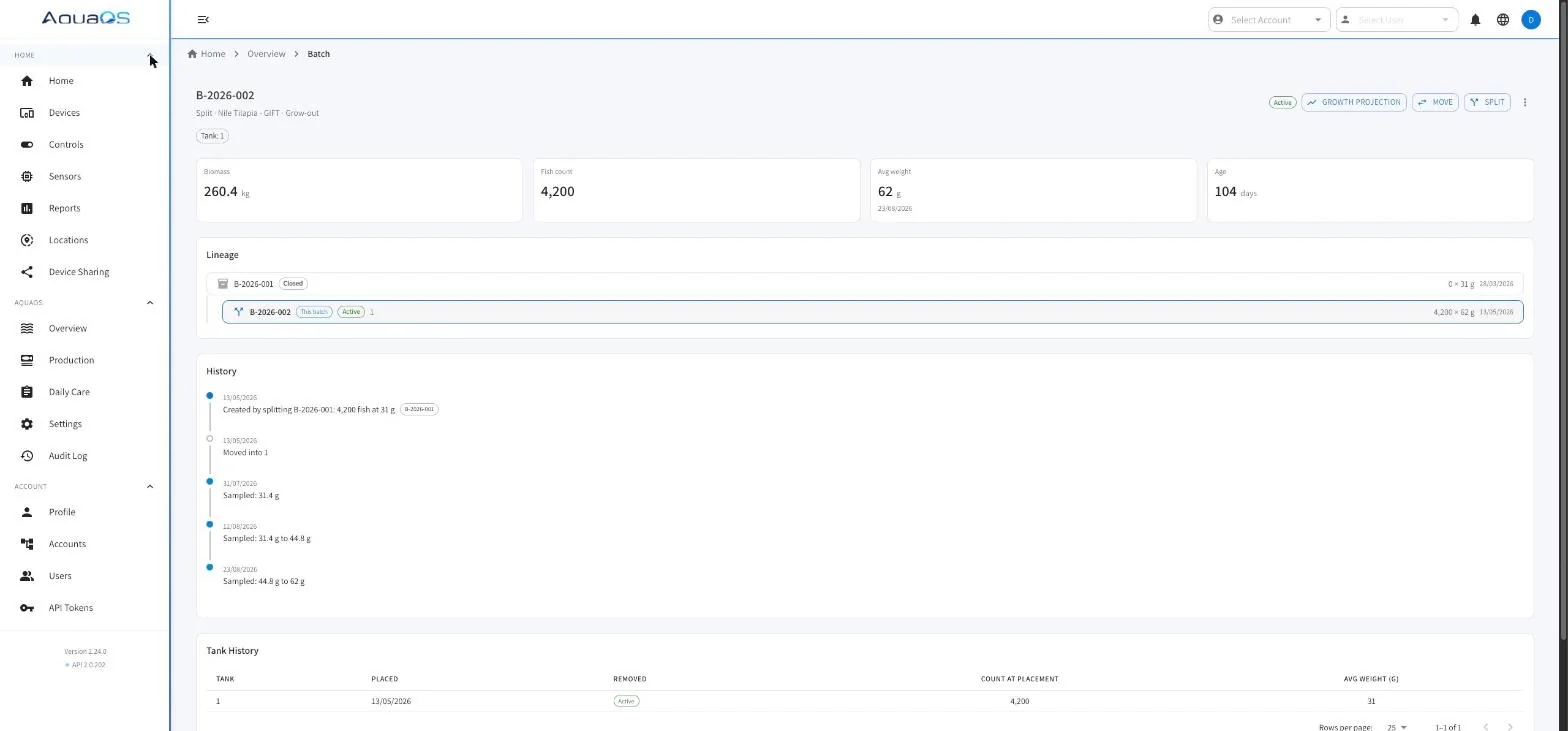
- Broodstock to nursery in one record
- Splits and grading as tracked events
- Per-variety and per-strain separation
- Reconciliation on every sorting session
The operations the platform is shaped around
Splitting is the primary workflow
Populations outgrow their unit constantly, and splitting is the most frequent operation on the floor.
In AquaOS a split apportions count and biomass across source and destination, leaves an accurate residual behind, and preserves the lineage link. This is the operation most production software treats as an edge case, and it is the one a hatchery does every week.
Grading sessions that reconcile
A grading day pulls from several units, produces size classes, and places each class somewhere different.
The session holds the fish while they are in the machine and checks the totals out against the totals in before it closes, so a grading day cannot silently rewrite the inventory.
Spawning as the start of the record
Broodstock groups, spawning events, hatch results, and failed spawns are recorded as production.
The resulting fry become ordinary batches, so a nursery population traces back to the group that spawned it without a separate hatchery spreadsheet in between.
Phases that match the operation
Cultivation phases are defined per farm rather than hardcoded.
Larval, nursery, pre-grow-out, and whatever the operation actually calls its stages are set up once, each with its own default feeding frequency, and stock moves between them explicitly.
Varieties kept distinct
Hatcheries commonly run several species and several varieties or strains of each.
Species and varieties are first-class, held per broodstock group and carried on every batch, so lines do not blur through nursery and grading.
Tight units, small volumes
Incubators and nursery tanks are location types with their own defaults for volume and feeding.
A hatchery does not have to model a 20-litre incubator with the same assumptions as a hectare pond.
A hatchery cycle in the record
-
Spawn
A spawning event is recorded against a broodstock group, with the outcome, successful or not.
-
Hatch
A successful hatch creates a batch with a count and average weight in an incubator or nursery unit, linked to the group.
-
Split
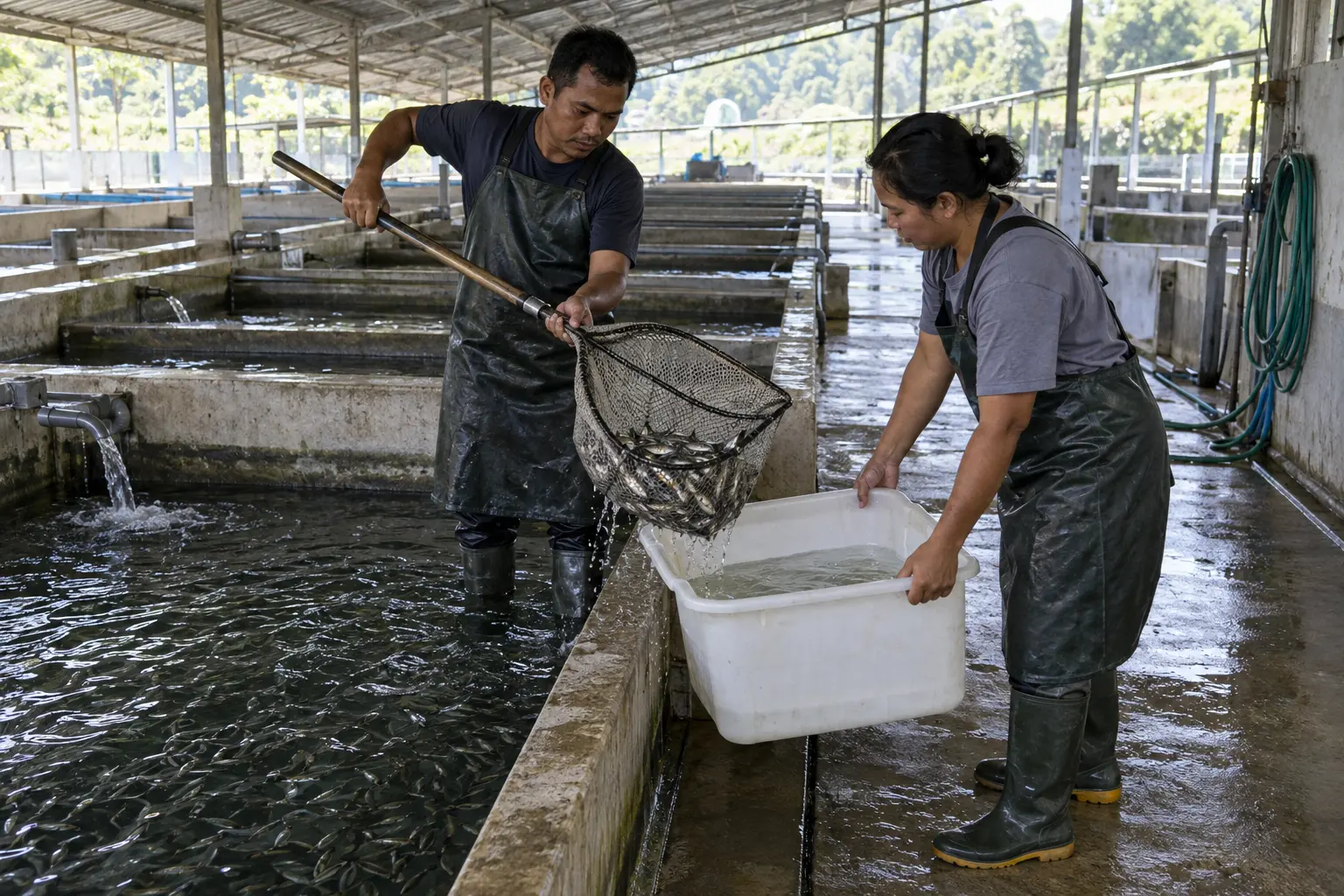
As density rises the population is split across units. Counts, biomass, and lineage follow every move.
-
Grade and hand off
A sorting session grades the population into size classes, each placed in its destination or released to grow-out or sale.
What a hatchery gets out of it
An inventory figure that survives the week
After three splits and a grading session, the count per unit is still correct. That single property is the difference between a system a hatchery trusts and one it maintains a parallel notebook against.
Broodstock performance you can compare
Spawning outcomes, including failures, attributed to durable groups over seasons. Which group produced what stops being a matter of recollection.
Customer traceability
A fingerling delivery traces back through grading, nursery, and hatch to the broodstock group. Buyers asking for provenance get an answer from the record.
Frequently asked questions
Does AquaOS handle several species in one hatchery?
Yes. Species and their varieties are defined per operation and carried on every broodstock group and batch, so a hatchery running several species and several strains of each keeps them distinct through spawning, nursery, grading, and delivery.
How are incubators handled differently from ponds?
Growing units have a type, and each type carries its own defaults for volume, area, and feeding. An incubator, a nursery tank, and a grow-out pond are all growing units, but they do not inherit the same assumptions.
Can partial harvests and partial sales be recorded?
Yes. Stock can leave a unit partially through a split, a transfer out, or a closure with a reason. The residual stays as a live placement, so a unit that was half emptied still reports the correct remaining count.
Is there a separate mobile interface for hatchery staff?
Yes. A mobile app runs alongside the web workspace for the operations done at the tank side, so splits, mortality, and feeding confirmation are recorded where they happen rather than typed up later. How floor staff should work is worth walking through against your own shift pattern.
See AquaOS on your operation
Bring a real production scenario. AquaOS is walked through on your operation, not a canned dataset.