Aquaculture water quality monitoring software
Water quality monitoring software records continuous sensor readings against the growing unit they were measured in, so every reading is attributable to the batch that was in the water. A monitoring dashboard tells you dissolved oxygen fell at 03:40. AquaOS tells you it fell in Pond 4, which held a specific batch at a specific density, that had been fed a specific ration that afternoon, and what the mortality was the next morning.
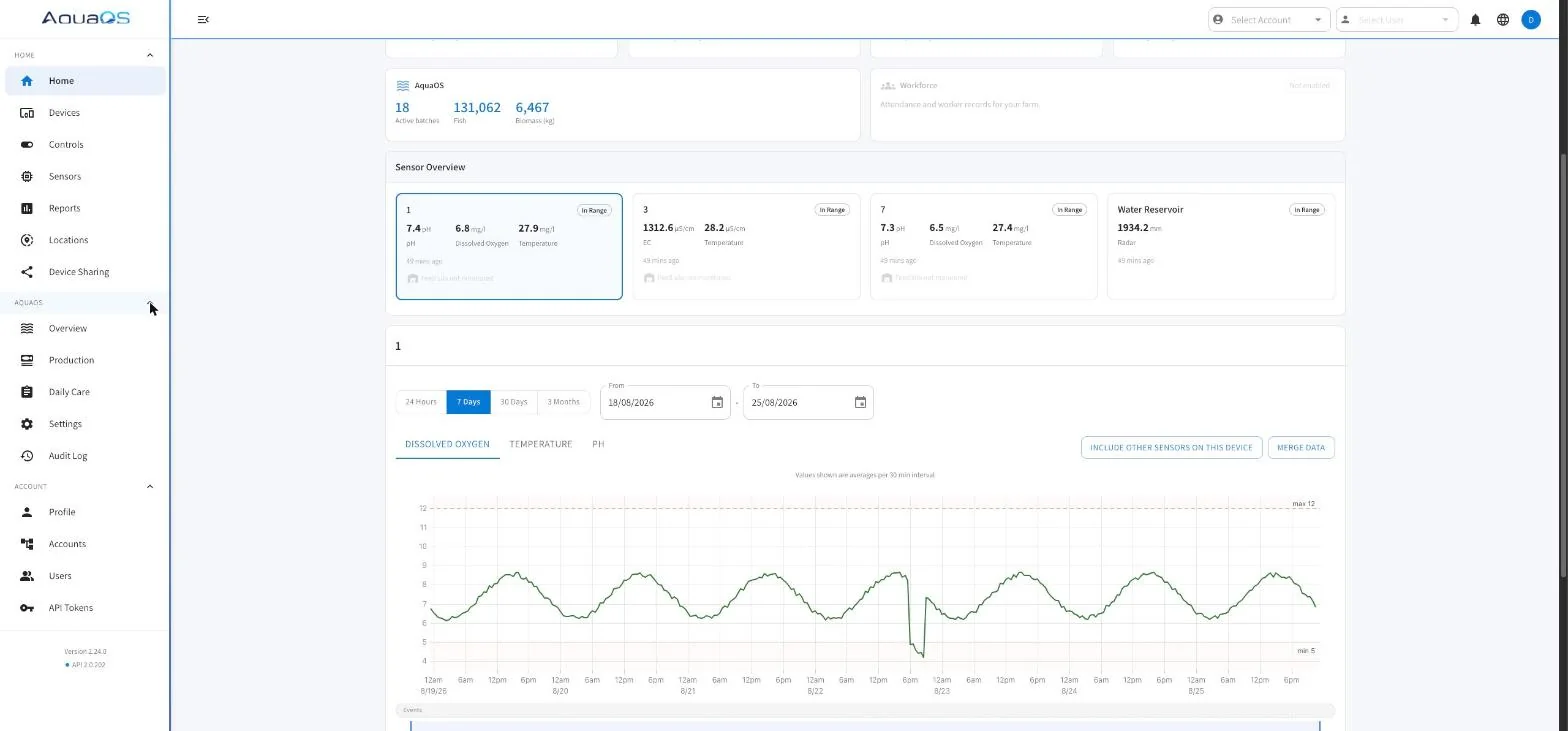
- Sensors bound to growing units
- Threshold alarms with notification
- Buffered on the controller when offline
- Plotted against the production record
How water quality works in AquaOS
Sensors bound to units
A sensor is assigned to a growing unit, not to an abstract device list.
Every reading is therefore attributable to the pond or tank it was taken in, and to whatever batch was in that unit at the time. The binding is stamped at write time, so a sensor later moved to another tank does not rewrite history.
Parameters
Dissolved oxygen, pH, temperature, electrical conductivity, ORP, ammonium, nitrate, turbidity, and other parameters, depending on which sensors are installed.
Any modern industrial sensor connects through the controller layer.
Threshold alarms
Per-sensor thresholds raise an alarm when a reading crosses them.
Alarms reach the people on duty and are visible on the dashboard as active alerts against the unit, so the response is attached to a place rather than a device serial number.
Offline buffering
Controllers are cellular-native, so a remote pond needs no site network.
When the cellular link drops, readings are buffered on the controller and delivered when it returns. The record has no gap, which matters most for the events that happen at night on the far side of the farm.
History in context
The per-pond report plots water quality for the period alongside growth, feed, and mortality for the same unit.
A dissolved oxygen event and the mortality that followed it appear on the same page, not in two systems.
Readings from a phone at the tank side
Not every unit needs a permanent sensor.
A probe plugged into a phone through a USB adapter is read live by the mobile app, and the reading goes straight into the record: pinned to the growing unit the worker is standing at, tagged with who took it, when, and where, and plotted in the same history as the continuous data. Nothing is written on paper and nothing is typed in later. A reading can also be entered by hand when there is no probe at all.
How a reading reaches the record
Two ways in, one record. A fixed sensor is read by a field controller on an interval; a probe on a phone is read at the tank side. Both are written to the growing unit with the same timestamp and the same binding, so the history does not know or care which path a reading took.
-
Sensor reads
An industrial probe in the water is read by a field controller on a fixed interval.
-
Controller sends
The controller reaches the platform over cellular. If the link is down, the reading is buffered locally and sent when it recovers.
-
Bound and stored
The reading is stored against the growing unit the sensor is assigned to, timestamped and attributable to the batch in that unit.
-
Alarm or archive
If it crosses a threshold, an alarm is raised and notified. Either way it joins the history that the per-pond report draws from.
What binding readings to units changes
Cause and effect in one view
Correlating an oxygen crash with the feeding that preceded it and the mortality that followed is a page view, not a reconstruction project across two systems and a notebook.
Alarms that mean something operationally
An alarm naming a pond and the batch in it is actionable at 03:40. An alarm naming a device identifier requires someone to remember where that device is.
Evidence for a claim
When a loss has to be documented for an insurer or an owner, the reading history, the mortality record, and the feed record for that unit and period come out of one report.
What changes when the probe is on the phone?
The handheld meter was never the problem. The clipboard between the meter and the record is.
The number gets written down
With a handheld meter The meter shows a value, someone writes it on a clipboard, and someone types it into a spreadsheet that evening, if the sheet is still open.
With a probe on the phone The app reads the probe live and saves the reading itself. Nothing is written down and nothing is typed in later.
Which pond was that?
With a handheld meter A column of numbers with pond names from memory. Two readings from the same round can land on the wrong units and nobody can tell.
With a probe on the phone The reading is pinned to the growing unit the worker is standing at, resolved from the phone position or chosen on screen, with the time and who took it.
The history lives in the meter
With a handheld meter Past readings sit in the handheld or in a notebook, apart from the sensors, the feed, and the mortality for that unit.
With a probe on the phone The reading lands in the unit water quality history next to the continuous readings, and the per-pond report draws on both.
Was the round done?
With a handheld meter A manager finds out that a pond was skipped when something goes wrong in it.
With a probe on the phone Every reading carries who took it, when, and where, so a unit with no reading today is visible today.
Frequently asked questions
Which water quality parameters does AquaOS support?
Whatever the installed sensors measure. Common deployments cover dissolved oxygen, pH, temperature, electrical conductivity, ORP, ammonium, nitrate, and turbidity. AquaOS is sensor-agnostic, so the parameter list is a function of the hardware on site rather than a fixed platform limit.
Do remote ponds need Wi-Fi or a site network?
No. Controllers are cellular-native and reach the platform directly. Sites with no network coverage at the pond edge are the normal case rather than the exception, which is why buffering on the controller exists.
What happens to readings when the connection drops?
They are buffered on the controller and delivered when the link returns. The stored history is filled in for the period that was offline, so the record does not have a hole where the outage was.
Can a handheld probe reading go straight into the record?
Yes. The same digital probes that connect to a controller also plug into a phone through a USB adapter. The mobile app reads the probe live and writes the reading to the growing unit with the worker, the time, and the GPS position, and it appears in the unit history and the per-pond report next to the continuous data. There is no transcription step, so there is nothing to copy from a notebook or a spreadsheet.
Can water quality be recorded without sensors?
Yes. A farm can start with probe readings from a phone, or with readings entered by hand against a growing unit, and instrument specific units with fixed sensors later. All three paths land in the same history.
What happens if a sensor is moved to another tank?
The unit binding is recorded at the time each reading is written, not looked up when the report is generated. Moving a sensor changes where future readings land and leaves the existing history attributed to the unit it was actually in.
See AquaOS on your operation
Bring a real production scenario. AquaOS is walked through on your operation, not a canned dataset.