Monitoring remote ponds: what it actually takes
Connectivity, power, and data binding decide whether pond monitoring works. What to specify before buying, and why an unbound reading answers nothing.
5 min read
Continuous water quality monitoring on a pond cluster is usually specified as a sensor purchase. That is the wrong frame, and it is why a lot of deployed monitoring produces charts nobody uses. The sensor is the easy part. Three other decisions determine whether the system is worth having.
Connectivity is the first constraint, not the last
Pond clusters are rarely near anything. The default engineering instinct is to extend the site network out to the water: run fibre or copper, put in an outdoor access point, bridge to the far ponds. That turns a monitoring project into a civil works project, and it is the single most common reason a monitoring plan stalls at the quote stage.
Cellular-native field controllers avoid the problem entirely. The controller reaches the platform over the mobile network directly, so the pond edge needs no site infrastructure. The deployment cost is a mounting post and a controller rather than a trenching contract.
The follow-on question is coverage, and it is worth checking honestly rather than optimistically. Marginal cellular at the far ponds is normal. Which is why the second decision matters more than the first.
Buffering decides whether the record has holes
A controller that only transmits will lose whatever it read while the link was down. That sounds like a minor gap until you notice the correlation: cellular outages and the events you most need to document are both more likely at night and in bad weather.
A controller that buffers stores its readings locally when the link drops and delivers the backlog when it recovers. The stored history then has no hole for the outage period, which is the difference between being able to document an overnight oxygen crash and having a blank stretch in the record exactly where the loss happened.
Specify buffering explicitly. It is not a universal feature, and it is not usually on the front of the datasheet.
The reading has to know where it was taken
This is the decision that gets skipped, and it is the one that determines whether the data ever gets used.
A monitoring platform typically stores readings against a device. Device 7 reports 4.1 mg/L at 03:40. That is a fact, and on its own it is close to useless. Acting on it requires knowing which pond device 7 is in, which batch is in that pond, at what density, and what it was fed the previous afternoon. If the platform does not hold the production record, that correlation is a manual reconstruction across two systems, done days later, by someone reading a notebook.
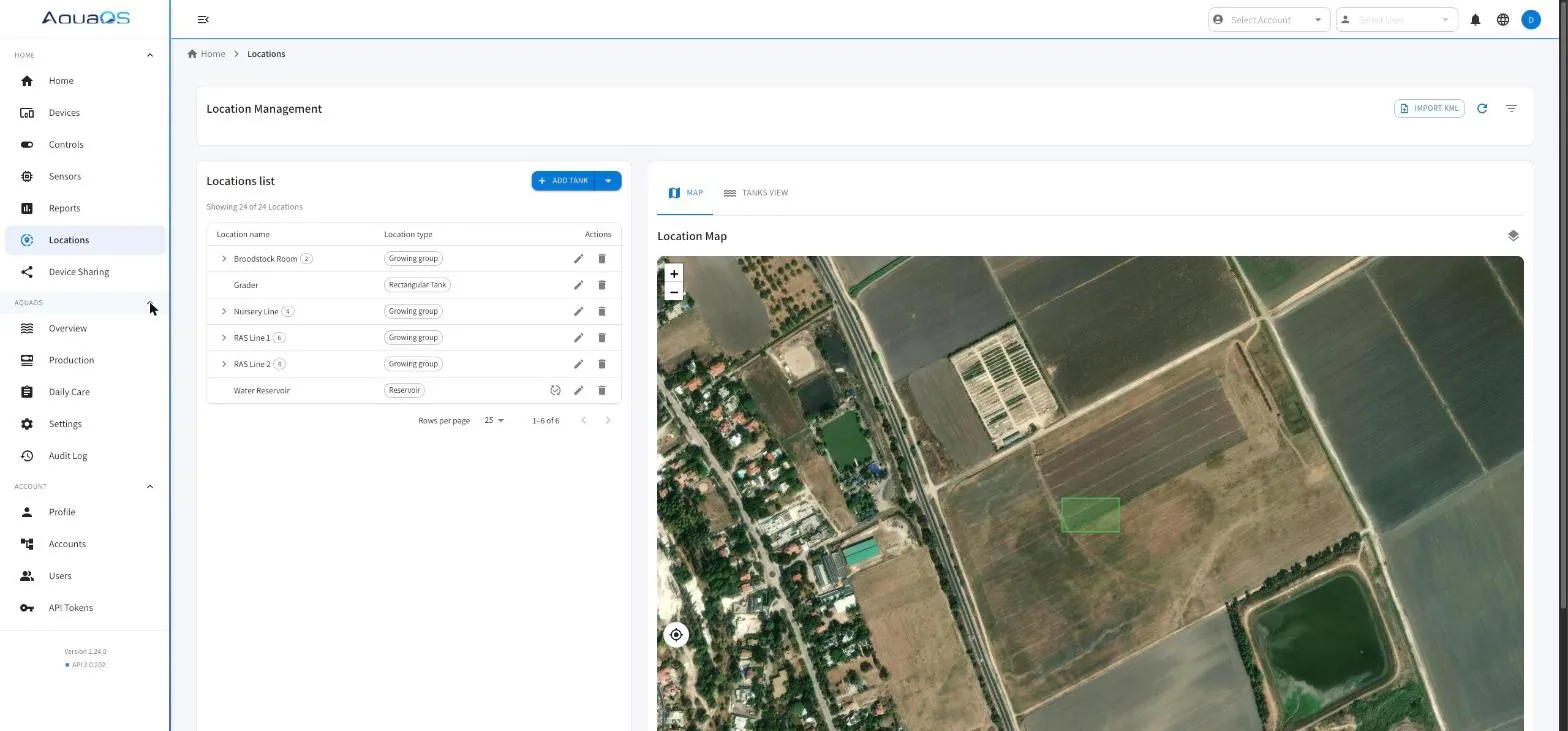
Binding the sensor to a growing unit rather than a device list fixes it. The reading arrives attributed to Pond 4, and Pond 4 already has a batch in it with a count, an average weight, and a feeding history. An alarm at 03:40 then names a pond and the stock in it, which is actionable by whoever is on call. See water quality monitoring for how that binding works.
One detail worth asking about: the binding should be recorded when each reading is written, not resolved when a report is generated. Sensors get moved between tanks. If the platform resolves the binding at read time, moving a probe silently rewrites months of history to claim it was measured somewhere it never was.
Alarms that reach a person
A threshold breach that only appears on a dashboard is a threshold breach nobody sees, because at 03:40 nobody has a dashboard open. Alarms need to be delivered, and they need enough context in the delivery to act on: the unit, the parameter, the value.
Two things worth specifying:
- Per-sensor thresholds, because a nursery tank and a grow-out pond do not share a lower bound.
- Acknowledgement, so a responded alarm is distinguishable from one that was slept through.
What to specify before you buy
A practical checklist for a remote pond deployment:
- Connectivity per location. Cellular coverage at the actual pond edge, not at the office. Test before ordering.
- Buffering behaviour. What happens to readings during an outage, and how much can be stored.
- Power. Battery life under the reading interval you actually want, in the temperature range you actually have.
- Sensor compatibility. Whether probes you already own can be read, and whether adding a sensor is configuration or a firmware change. See hardware and integrations.
- Unit binding. Whether readings are stored against a growing unit or a device, and whether that binding is stamped at write time.
- Data egress. Whether you can pull the readings out over an API without an upgrade.
Starting smaller than the full farm
Instrumenting every pond at once is rarely the right first move. The units where continuous monitoring changes a decision are usually a small subset: the highest-value stock, the densest units, and the ones furthest from anyone walking past.
A production platform that also accepts manual readings makes that staged approach workable, because the instrumented and non-instrumented units live in one water quality history rather than two systems. Start where the risk is, add units where the data proves useful, and keep the record continuous either way.
Remote pond clusters are the common case here, and shrimp farm management software covers how a cluster reads when every pond runs its own cycle.
If you are scoping a deployment, the specifics of coverage, probe compatibility, and reading interval are worth putting to someone with the model numbers in hand. That conversation is available through a demo, and the wider platform evaluation framework is in the buyer guide.