Grading fish: what a grading day must record
Grading fish moves a whole unit's stock in hours. What the record must hold: sources, residuals, size classes, destinations and a reconciled count.
6 min read
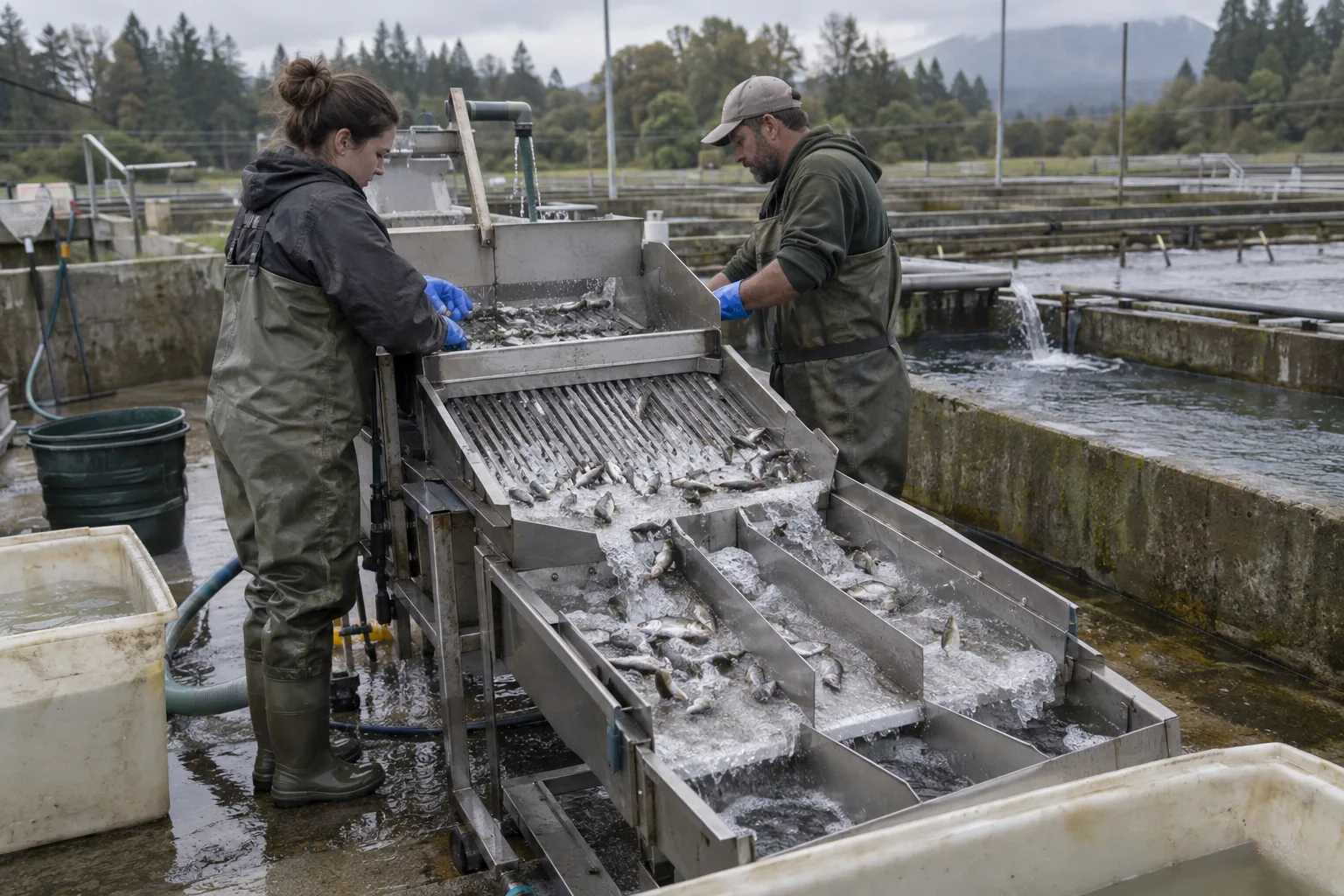
Grading fish is routine work on almost every operation, from hatcheries splitting fry by size to grow-out farms evening out a pond before harvest. It is also the day the production record is most likely to break. In a few hours a whole unit’s stock goes through a machine, comes out in several size classes and lands in units that may already hold fish. Whatever the record fails to capture that day stays wrong for the rest of the cycle.
This guide covers what a grading day has to leave in the record, why paper and spreadsheets tend to lose it, and how to check in a demo whether a system holds it.
Why grading breaks a paper record
On a normal day, a unit’s record changes a little: some feed, a few mortalities, perhaps a sampling. On a grading day, everything changes at once. Several units empty, partly or fully. Fish that were three populations become four or five size classes. Some classes go into empty units, some join stock already in place.
A paper sheet usually records where the fish went, because that is what the crew writes down at the machine. What it rarely records is the balance: how many left each source against how many arrived in each destination. Without that balance, the difference between the two does not disappear. It resurfaces weeks later as mortality nobody saw, or as a unit that harvests more fish than it was supposed to hold. By then there is no way to know which grading caused it. The same pattern is behind most of the inventory drift on a farm.
What the record has to hold
The sources, and what stayed behind
A grading starts by pulling fish from one or more source units. The record needs each source and how many fish came out of it. Just as important is what stayed behind: a unit is often only partly emptied, and the residual left in it is still a live population with its own count. If the record treats a partly emptied unit as empty, those fish vanish on paper while they keep eating.
The pool while the fish are in the machine
For a few hours, the fish taken from the sources are not in any unit. They are in transit, in the grader and the channels behind it. A record that forces them to stay in a source or jump straight into a destination misrepresents the day. In AquaOS, a sorting session holds this pool itself, at a sorting station defined for the site, so the stock is always somewhere in the record.
Each size class, with a count and an average weight
What comes off the grader is a set of size classes. Each one needs its own count and its own average weight, entered as it is produced. Those two numbers are what make biomass per unit calculable afterwards. A class recorded as “large fish to pond 4” with no count is a gap the next sampling has to close by guesswork.
The destination of each class
Each class goes somewhere: into an empty unit to start a new batch, or into a unit that already holds fish. The second case is where many systems fail. When a class joins existing stock, both groups need to remain identifiable in the shared unit, each with its own count and average weight, so growth and conversion stay measurable per batch rather than blurring into one.
A reconciliation before the day is closed
Before the grading is closed, what came out of the sources has to be compared against what went into the destinations. Any difference needs to be resolved or explained there and then, while the crew still remembers what happened: fish lost in the machine, a count estimated by weight, a class that went to the wrong unit. A system that closes a grading without that check is a system that hides the error in the stock figures.
Lineage from the new classes back to the source
A grading splits one batch into several and sometimes merges several into one. Each new group should carry a link to the batch it came from, so a market-size lot can be traced back through every grading to its origin. That lineage is what production tracking is built on, and it matters well beyond traceability: it is how the growth and survival of a cohort stay readable after it has been graded three times.
The morning after
Feeding plans are calculated per unit from biomass. After a grading, every unit involved has a different population: fewer fish, more fish, a different average weight. If the record is updated at the end of the week, the farm feeds the old populations for several days, overfeeding the unit that was emptied and underfeeding the one that received the largest class.
When the grading is recorded as it happens, every affected unit has its new count and average weight when the session closes, and the next morning’s rations are calculated from them. The same numbers feed the next feed conversion figure and the growth rate between samplings, which is why an unrecorded grading shows up later as a conversion nobody can explain.
What a closed grading should look like
Once a grading is closed, it should stay in the record as it happened: the sources, the residuals, the classes with their counts and weights, and where each one went. That read-only record appears in the lineage of every batch it produced and on the report of every unit involved. When someone asks six months later why pond 7 held more fish than expected, the answer is one click away instead of a search through old notebooks.
In hatcheries, where grading happens far more often than in grow-out, this is the difference between a record that holds up and one that is rebuilt every month. The hatchery and fish farming pages cover how the rest of the cycle is recorded around it.
What to test in the demo
- A partial empty. Grade from a unit and leave a residual behind. Check that the residual stays in the source as a live population with its count.
- Several sources at once. Pull from two units into one grading and check that each source’s contribution is recorded.
- A class into occupied water. Place one size class into a unit that already holds fish, and check that both groups keep their own count and average weight.
- A count that does not balance. Enter classes that total fewer fish than came out of the sources, and see whether the system lets the grading close without an explanation.
- The next morning. Ask for the feeding plan for the units involved and check that it uses the new biomass, not the one from before the grading.