Aquaculture feed records that hold up
Why most farm feed records measure the plan instead of the fish, what a defensible feed record contains, and how it changes the feed conversion figure.
5 min read
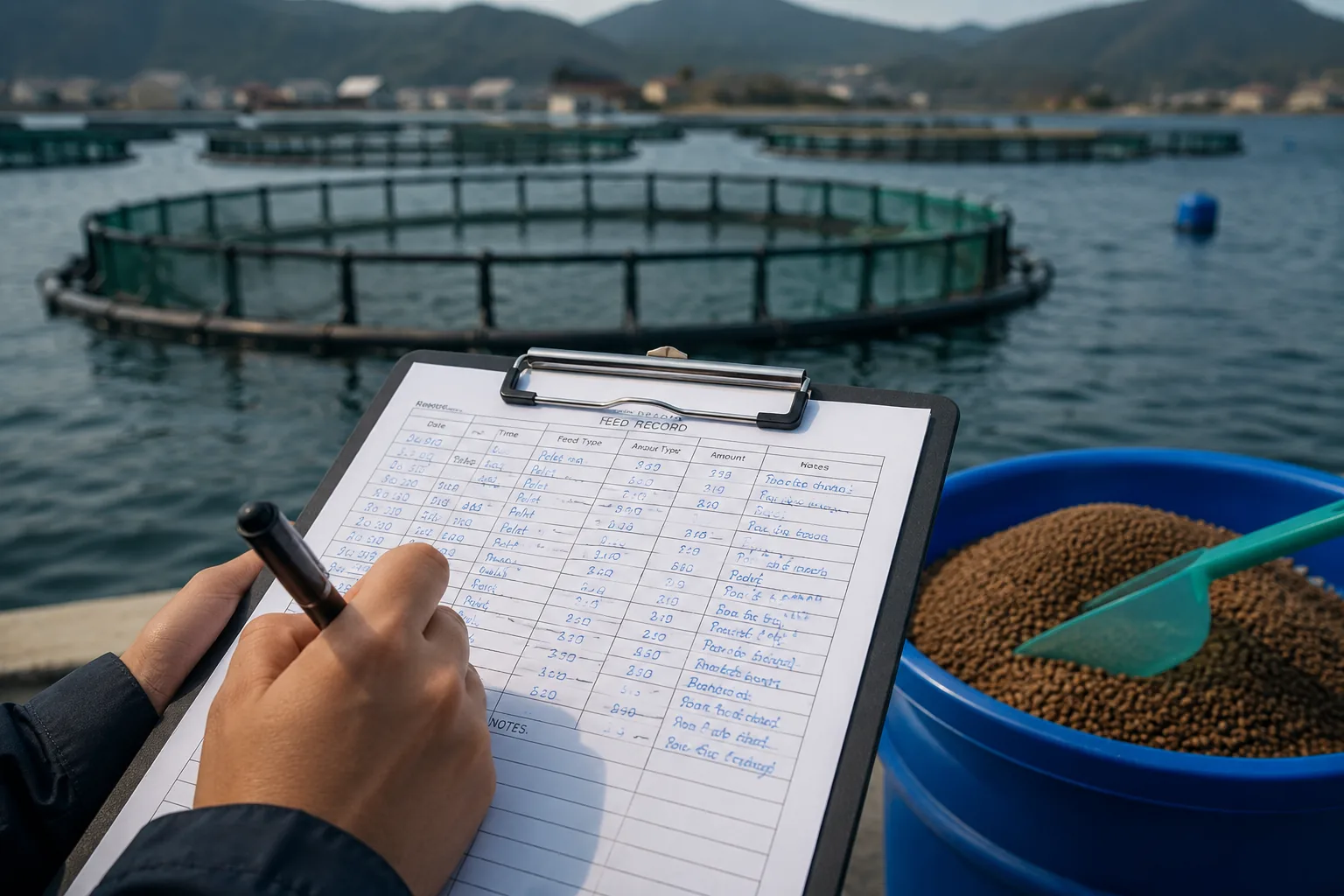
Feed is usually the largest recurring cost in an aquaculture operation, and it is routinely the least reliably recorded thing on the farm. Not because anyone is careless, but because of a specific and very common design choice: most systems record the feeding plan and treat it as the feeding record.
Those are not the same document, and the difference determines whether every downstream number is worth anything.
The plan is not the record
A feeding plan says: today, Pond 4 gets 38 kg, split across three feedings. A feeding record says: today, Pond 4 was fed 38 kg, confirmed at 07:40 and 13:10 and 17:55.
The distance between them is the days when the plan did not happen. Weather, a broken feeder, a treatment, staff shortage, a pond that was being harvested. Those days exist on every farm. In a system that only holds the plan, they are invisible, and the record confidently states that feed was delivered when it was not.
That single gap corrupts three things at once:
- Feed stock reconciliation. The system draws down inventory for feed that never left the bin, so on-hand stock drifts from reality and the reorder point arrives at the wrong time.
- Feed conversion. The numerator is inflated by feed that was never delivered.
- Diagnosis. A pond with poor growth looks like a biological or water quality problem when the actual cause is that it missed nine feedings last month.
The fix is not complicated. It is a confirmation step, with the negative case available: every unit is either confirmed as fed or explicitly marked not fed with a reason, and a day with neither is visibly missing rather than assumed. That is the core of how feeding and feed control works when it is built as a record rather than a schedule.
What a defensible feed record contains
Four things, and the fourth is the one most often missing.
A ration derived from current biomass. The daily amount should come from a feed matrix keyed to species, weight band, and cultivation phase, applied to the biomass actually in the unit today. If the ration is a static number someone updates occasionally, it lags the fish by weeks in a fast-growing phase.
Confirmation of delivery. Per unit, per day, ideally entered at the tank side rather than transcribed in the evening.
Explicit not-fed days. With a reason, so the record distinguishes “did not need feeding” from “nobody got to it”.
Feed item and stock drawdown. Which feed, in what quantity, drawn from a tracked stock level with a reorder threshold. Without it, feed spend cannot be attributed and the next order is sized by habit.
The biomass problem underneath
Even a perfect feed record produces a meaningless conversion ratio if the biomass figure is wrong, and biomass goes wrong for a reason that has nothing to do with feeding: stock movement.
When a batch is split across two ponds and only one side of the record updates, the ration for both is calculated from a biomass that no longer exists. The feed record can be immaculate and the conversion figure will still be nonsense, because feed given and weight gained no longer belong to the same animals.
This is why feed accuracy is downstream of production tracking. Getting the feed record right is necessary and not sufficient. Both halves have to hold.
Feed conversion, stated honestly
A feed conversion ratio for a pond over a period is feed given divided by biomass gain. Every term in that needs qualification:
- Feed given should come from confirmed feedings, not the plan.
- Biomass gain has to be adjusted for stock moved into and out of the unit during the period, and for mortality. A pond that received a transfer gained biomass without eating for it.
- The period matters. Between two samplings, biomass is projected from the growth model rather than measured, so a figure spanning that gap is partly model-derived.
That last point is where most systems quietly overstate their own precision. A conversion ratio calculated across a period with one sampling at each end is a reasonable estimate. The same ratio calculated across a period with no sampling is a restatement of the growth model, and presenting it with the same confidence trains people to distrust every number the system produces.
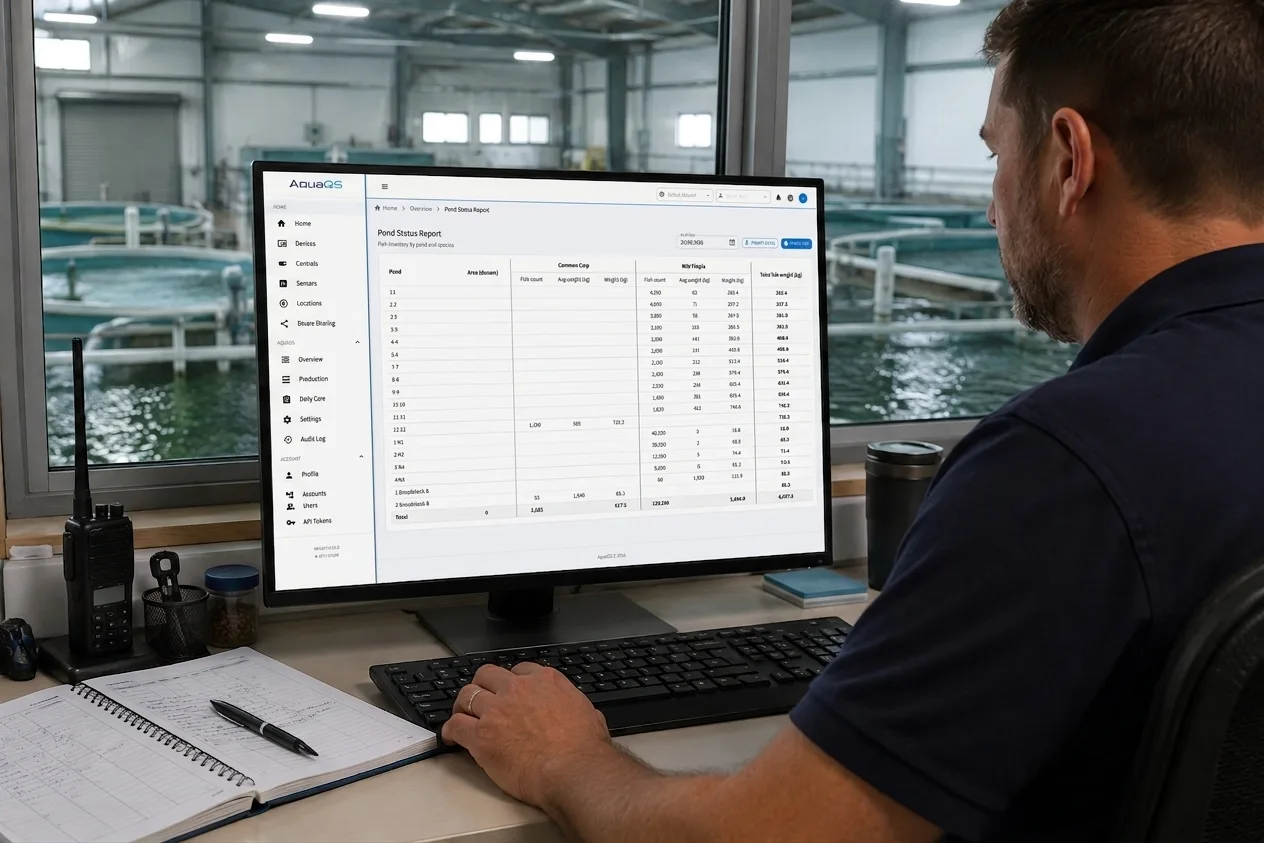
The right behaviour is to label it: state that the figure is an estimate, state what it is based on, and show the sampling dates it was anchored to. See reporting and traceability for how that appears on a per-pond report.
What changes when the record is real
Three things, in rough order of how quickly they show up.
Ordering gets sized to demand. Projected feed demand from current biomass and the growth model, compared against stock on hand, produces a feed runway in days per feed item. That replaces ordering on habit and discovering the shortfall on a Friday.
Underfed units surface early. A unit that quietly missed a week appears in the feed record within days rather than in the growth curve two months later.
Per-unit variance becomes visible. A farm-level conversion figure averages the good ponds with the bad ones. Per-unit records show the spread while there is still cycle left to act on it, which is the entire point of measuring it at all.
If you are evaluating platforms on this, the test worth running is simple: ask to see a not-fed day in the record, and ask how it affects the conversion figure for the period. The buyer guide has the rest of the evaluation, and a demo can be run against your own feed table rather than a generic one.