Aquaculture ERP vs production software: which first?
Where an aquaculture ERP stops and production software begins: which records each one owns, and which one a farm actually needs first.
5 min read
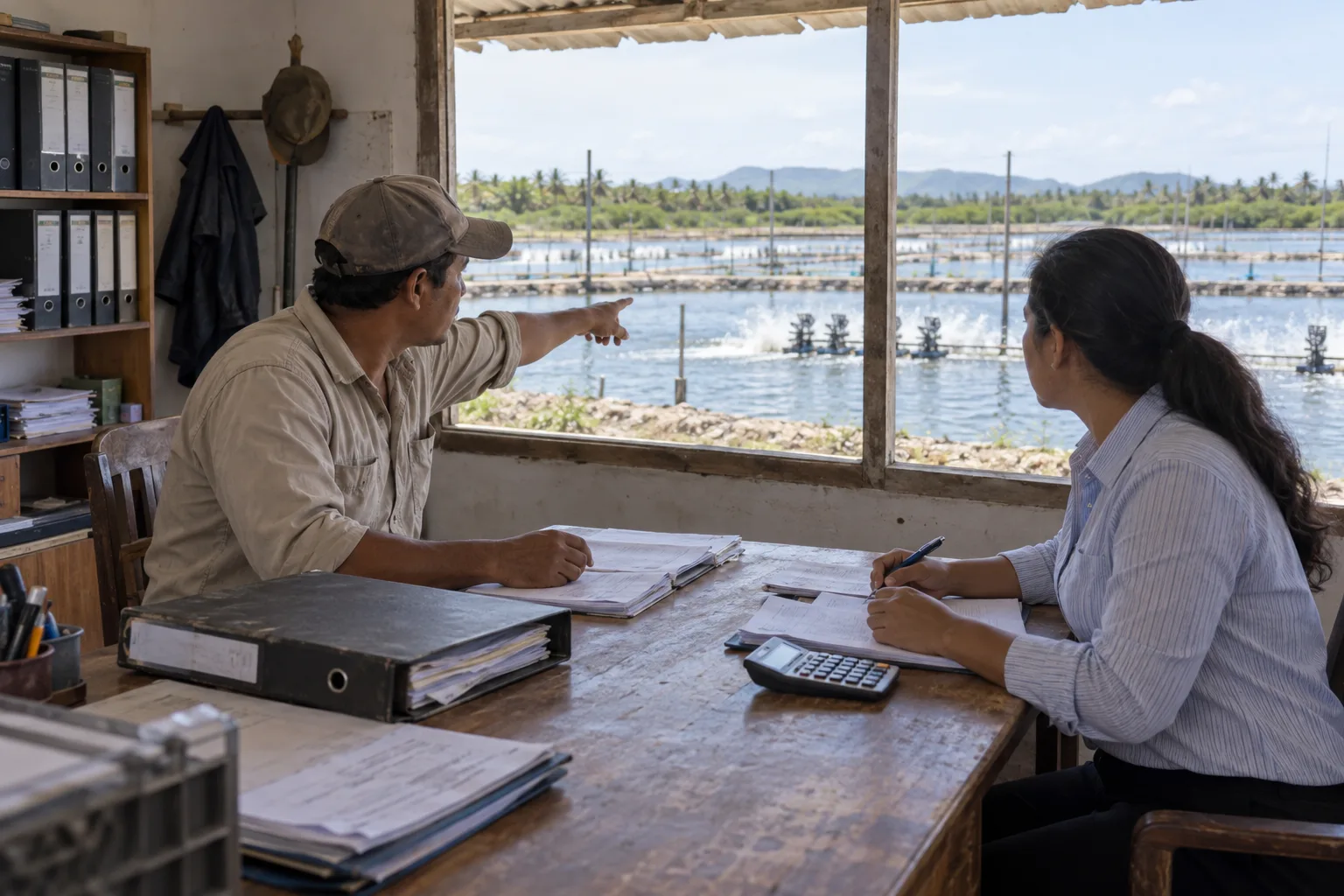
Search for aquaculture software and two different categories come back wearing the same label. One is the aquaculture ERP: business software with a farming configuration, built around purchasing, inventory, sales, and accounting. The other is production software, built around ponds, batches, feed, and mortality. Vendors on both sides describe themselves as the complete solution, which is how farms end up evaluating an accounting system against a production record and calling it a comparison.
The two are not rivals so much as different layers, and the practical question for a farm is not which is better. It is which one you are actually missing, and which one has to exist first. The buyer guide maps the whole category; this article draws the one line that matters most.
An ERP counts money, a production system counts animals
Strip the feature lists away and the division is clean. The ERP’s world is made of transactions: a purchase order, an invoice, a stock movement, a payment. Its job is to make the company’s money legible, and a good one does. The production system’s world is made of populations: a batch stocked into a pond, split across three more, fed daily, graded, harvested. Its job is to make the farm’s biology legible.
Trouble starts when one is asked to do the other’s job. Production events forced into transaction shapes lose exactly the details a farm runs on, and an aquaculture production platform asked to run company accounting would fail just as hard in the other direction. Neither failure says anything about product quality. The models are different because the problems are.
The ERP’s unit is a transaction, the farm’s is a batch
A batch of fish is a strange object for business software. It occupies several units at once, changes count and weight every day without any transaction occurring, and gets split, merged, and moved in ways that have no invoice attached. Aquaculture ERP configurations typically model stock as inventory items with quantities, which works right up until the first three-way split, the first grading day, or the first co-mingled pond.
This is where evaluation should concentrate, because it is where the archetypes genuinely differ. A system built on batches and placements treats a split as a normal recorded operation. A system built on inventory rows treats it as an adjustment someone has to make come out right by hand.
Feed is where the boundary shows
Both categories claim feed management, and both are telling the truth about their own half. The ERP half is procurement and stock: what was bought, what it cost, what remains in the warehouse. The production half is biological: a ration per pond derived from current biomass and the farm’s own feed table, confirmed daily, including the days a pond was skipped. Feed conversion, the number that decides whether a cycle made money, can only be computed from the second half. No purchasing record, however precise, knows what the shrimp actually ate.
Traceability lives where the events live
When a buyer, a certifier, or an inspector asks about a lot of harvested fish, the question is never about invoices. It is where the animals came from, what they were fed, what happened in their water, and what else shared it. Answering that requires the chain of production events: the stocking, every split and transfer, the feed record, the mortality. An ERP can attach documents to a sale; it cannot reconstruct a lineage it never recorded.
This is worth weighing early because traceability requests arrive on the buyer’s schedule, not the farm’s. The operations that answer them in an afternoon are the ones whose production system was recording lineage all along, and the export markets that demand it are usually the ones worth being in.
Production comes first, because it feeds everything else
For most farms the sequencing argument settles the choice. The office already has some system for money. The water usually has nothing but a workbook. And the flow of information runs in one direction: harvest records become sales, feed consumption becomes cost of goods, stock in the water becomes the balance sheet’s biological assets. Every one of those office numbers is derived from the production record, so a farm that installs the ERP first has built the second floor before the first.
The handover itself is not exotic. Per-unit and per-cycle reports export to Excel and PDF, which is how most offices consume them, and a REST API covers the operations that want the ERP pulling records automatically.
When a farm genuinely needs both
Past a certain size the ERP question answers itself: multiple companies, processing lines, export documentation, dozens of buyers. Integrated operations at that scale run both layers, and the pairing works precisely because each stays on its side of the line. What almost never survives contact with a real farm is the single system claimed to do it all. When someone makes that claim in a demo, ask to see a grading day and a payroll run in the same product, and watch which one turns out to be a slide.
If the production layer is the missing one, the evaluation is straightforward: bring your own pond list and feed table, and have it worked through live in a demo. The office software can keep doing what it already does well.